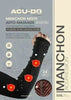
 DIY work is one of the main causes of tendinitis and arm pain among active adults. Screwing, sanding, painting, cutting, or using a drill for hours intensely engages the tendons and muscles of the forearm, elbow, and shoulder. If these tensions are not relieved after exertion, they accumulate and can develop into persistent pain or established tendinitis. ACU-DO Shiatsu self-massage helps relieve these tensions effectively and naturally, in just a few minutes after your work.
Why does DIY work cause arm pain?
Amateur or professional DIY work exposes the arms to stresses similar to those experienced by manual workers, but without the physical preparation or structured breaks found in professional settings. This is why it is a frequent cause of tendinitis and joint pain.
The 5 mechanisms behind DIY-related pain
-
Repetitive movements: repeatedly screwing, sanding, cutting, or hammering continually stresses the same tendons (forearm extensors, Large Intestine meridian), creating cumulative microtrauma
-
Gripping efforts: holding a tool, tightening a wrench, or forcefully holding a drill engages the wrist and forearm flexor muscles (Heart Protector meridian, points PC 3/5/7)
-
Tool vibrations: drills, screwdrivers, and sanders transmit vibrations to the tendons and joints, promoting elbow inflammation (Large Intestine meridian points 10 and 11)
-
Prolonged awkward positions: working with the arms raised, twisted, or extended creates tension in the shoulder and rotator muscles (Triple Energizer meridian)
-
Lack of recovery: the weekend DIY enthusiast performs in a few hours an effort that their body is not accustomed to, without an appropriate recovery protocol
These five combined factors explain the well-known "occasional DIY enthusiast" phenomenon: intense pain on Monday morning after a weekend of work, sometimes lasting for several days.
Which areas of the arm are most affected by DIY work?
The elbow: lateral epicondyle and tendinitis (the DIY enthusiast's tennis elbow)
The lateral epicondyle is the external bony prominence of the elbow where the tendons of the forearm extensors attach. Repetitive screwing, tightening, and gripping movements constantly pull on these tendons, causing progressive inflammation: this is lateral epicondylitis, nicknamed "tennis elbow" but very common among DIY enthusiasts. Points LI10 and LI11 of the Large Intestine meridian, stimulated by the ACU-DO Sleeve, are directly associated with this area.
The forearm: extensor and flexor tension
The extensor muscles (on the back of the forearm) and flexor muscles (on the inner side) are under constant strain during DIY work. The extensors are especially used for screwing and sanding movements. The flexors are used for tightening and holding tools. Points PC5/6/7 (Pericardium 5/6/7) on the inner forearm are the key TCM points for the flexors.
The shoulder: rotator muscle tension
Working with the arms raised (ceiling, high partition), extended (reaching a distant area), or applying force (drilling into a hard wall) quickly fatigues the rotator cuff muscles. Point TE14 (Triple Energizer 14), located in the hollow beneath the acromion, is the most effective TCM point for relieving this tension.
The ACU-DO Arm Sleeve TCM points: targeted action on areas used by DIY enthusiasts
The ACU-DO Arm Sleeve automatically positions its beads over acupuncture points from traditional Chinese medicine (TCM) directly associated with areas used during DIY work. Here is their specific role.
Tendinitis & arm pain – ACU-DO Shiatsu massage – VSAH
|
TCM Point |
Meridian |
Location |
Benefits for DIY enthusiasts / artisans |
|
LI4 (Hegu) |
Large Intestine |
Back of the hand, between the thumb and index finger |
Relieves general upper-limb pain, reduces inflammation after manual exertion, and promotes overall arm relaxation |
|
LI10 (Shousanli) |
Large Intestine |
Forearm, 2 cun below LI11 |
Tones and relaxes the forearm extensor muscles: an area directly overloaded during screwing and sanding |
|
LI11 (Quchi) |
Large Intestine |
Outer end of the elbow crease |
Major anti-inflammatory elbow point: treats lateral epicondylitis in DIY enthusiasts (tennis elbow), elbow inflammation |
|
TE5 (Waiguan) |
Triple Energizer |
Back of the forearm, 2 cun above the wrist |
Relieves lateral arm pain and improves wrist mobility after gripping exertion |
|
PC3/5/7 |
Pericardium |
Inner forearm, above the wrist |
Relaxes the wrist flexor muscles overloaded by prolonged gripping of tools |
|
SI3 (Houxi) |
Small Intestine |
Ulnar edge of the hand, below the 5th metacarpal |
Acts on neck pain associated with tension in the dominant arm and prolonged uncomfortable positions |
|
SI8 (Xiao hai) |
Small Intestine |
Posterior edge of the elbow, in the hollow of the depression |
Relieves deep tension in the elbow and arm after drilling and handling work |
TCM source: TCM Benefits of the ACU-DO Arm Sleeve | Points & Meridians – VSAH and TCM Benefits of the ACU-DO Back Boxer | Points & Meridians – VSAH and TCM Benefits of the ACU-DO Ankle Bracelet | Points & Meridians – VSAH
ACU-DO protocol according to your type of DIY work
Screwing, drilling, and assembly work (fixtures, carpentry)
Screwing and drilling work primarily strains the extensors of the right forearm (or the left for left-handed users) and the elbow. These are the tasks most frequently associated with tennis elbow in DIYers.
-
Immediately after working: ACU-DO Right Arm Sleeve, for at least 15/30 minutes, with the arm resting on a table
-
TCM focus: Large Intestine 11 (elbow) + Large Intestine 10 (forearm extensors) + Triple Burner 5 (wrist)
-
If both arms were used: Right + Left Pack for 15/30 minutes
ACU-DO Arm Sleeve | Relieve the elbow and forearm after screwing and drilling
Tendinitis & arm pain – ACU-DO Shiatsu massage – VSAH
Painting, sanding, and finishing work
Painting and sanding put strain on the shoulder (raised arm, wide movements) and the forearm muscles (continuous pressure). Hairdressers and painters experience tension in the same areas.
-
After painting or sanding: ACU-DO Right + Left Arm Sleeve, at least 15/30 minutes
-
TCM focus: Triple Burner 14 (shoulder) + Large Intestine 10 (forearm)
-
Additional option: ACU-DO Back Boxer for at least 30/60 minutes for the lower back if you worked lying down or squatting
Pain recovery after painting and finishing work
ACU-DO Right + Left Arm Sleeve Pack| Tendinitis & epicondylitis – VSAH
Plumbing, electrical work, and precision tasks
This work combines uncomfortable positions (under the sink, inside an electrical panel), repeated precision movements, and tightening efforts. The wrists and forearms are particularly exposed.
-
After working: ACU-DO Sleeve for the dominant arm, at least 30/60 minutes
-
TCM focus: Pericardium 3 to 7 (wrist flexors) + Triple Burner 5 (wrist mobility) + Large Intestine 11 (elbow)
-
For left-handed users: ACU-DO Left Arm Sleeve, specifically coded for the TCM points of the left arm
Relieve your arms after precision work
Tendinitis & arm pain – ACU-DO Shiatsu massage – VSAH
The complete ACU-DO routine for DIYers: before, during, and after
Before starting work (15 min): prepare the tendons
A short 15-minute session with the ACU-DO Sleeve before starting your work activates circulation in the arm meridians and prepares the tendons for exertion. This tendon-repair principle significantly reduces the risk of acute injury during unusual work.
After 2 to 3 hours of work (15/30 min): stop the buildup
If your work lasts several hours, taking a break with the sleeve after 2 to 3 hours of continuous work interrupts the cycle of micro-tension buildup. 15/30 minutes is enough. This is the equivalent of a “reverse warm-up” that provides relief before the pain sets in.
After the work (30 to 60 min): complete recovery
The post-work session is the most important. Thirty to 60 minutes of stimulating the 7 TCM points allows the tendons and muscles that were engaged to relax deeply. You can sit with your arm resting on a flat surface and your elbow at a 90-degree angle if the pain is severe. Let the massage beads do their work, and if necessary, press on them to intensify the treatment.
Discover the ACU-DO Arm Sleeves | Relieve tendinitis and DIY-related tension | Tendinitis & arm pain – ACU-DO Shiatsu massage – VSAH
|
Made in France |
Responsible design |
Delivery in 2 to 6 days |
Secure payment |
To learn more
ACU-DO | Relieve your everyday pain – Shiatsu massage – VSAH
Back pain & sciatica – ACU-DO Shiatsu massage – VSAH
Tendinitis & arm pain – ACU-DO Shiatsu massage – VSAH
Swollen ankles & water retention – Shiatsu massage – VSAH
Construction: relieve workers’ arm and back pain – VSAH
Listen to your body: identify tension and prevent pain with ACU-DO – VSAH
Everyday well-being: take care of yourself – Shiatsu self-massage – VSAH
Prevent arm, ankle, and back pain – ACU-DO Shiatsu self-massage – VSAH
Martial arts–combat sports: recovery and relaxation with ACU-DO – VSAH
Self-massage between sessions: extend the benefits of physiotherapy treatments – VSAH
Water retention: relieve swollen ankles and legs – VSAH
FAQ - Frequently asked questions about arm pain from DIY work
Why do your arms hurt after DIY work?
Post-DIY pain is caused by cumulative microtrauma in the tendons and muscles of the forearm, elbow, and shoulder. Repetitive movements (screwing, sanding, cutting), gripping efforts (squeezing tools), and vibrations from power tools place intense strain on the forearm extensors and shoulder muscles. Without adequate recovery after exertion, this microtrauma accumulates and causes painful inflammation within 12 to 48 hours after the work.
How can elbow tendinitis be quickly relieved after DIY work?
To quickly relieve elbow tendinitis (lateral epicondylitis) after DIY work, combine the following: apply ice to the elbow wrapped in a cloth to prevent skin burns for 15–30 minutes to reduce acute inflammation, then stimulate the Large Intestine 10 and 11 points with the ACU-DO Sleeve to relax the tendons. Avoid activities that strain the elbow for 24 to 48 hours. If the pain persists for more than 3 days, consult a doctor.
How long should the ACU-DO Shiatsu self-massage sleeve be used after DIY work?
30 to 60 minutes after the work is sufficient for effective recovery. This duration allows stimulation of the 7 TCM points to deeply relax the tendons and muscles that were used. For intensive work (a full day of renovation), a 30-minute session in the evening and another 30-minute session the following morning are recommended. If needed, press the massage balls to intensify the treatment in the form of DO-IN.
Is the ACU-DO Shiatsu self-massage sleeve suitable for left-arm pain?
Yes. The ACU-DO Sleeve is available in a Left Arm version, specifically designedé for TCM points on the left arm. Left-handed DIYers, or those who have mainly used their left arm, should use the Left Arm Sleeve rather than the Right Arm Sleeve.
Can it be usedACU-DO Shiatsu self-massage sleeve
if you already have established tendinitis?
In the case of acute tendinitis (active inflammation with heat, redness, and swelling), wait until the inflammatory phase has passed, generally 48 to 72 hours, before using ACU-DO. After this phase, stimulating points such as Large Intestine 10 and 11 helps accelerate tendon healing and reduce residual pain. In the case of chronic tendinitis, regular use of ACU-DO may reduce the frequency of painful flare-ups, but it should not replace medical advice. It is a complementary tool.
Should I buy the Right Arm, Left Arm, or Right + Left Pack?
If you mainly use one arm (the dominant arm for most DIY tasks), start with the corresponding sleeve: Right Arm for right-handed people, Left Arm for left-handed people. If you have used both arms (painting, sanding, carrying) or want bilateral preventive care, the Right + Left Pack is more economical than two separate purchases and allows simultaneous treatment of both arms.
Keywords
Information
-
, even Author Article title
-
, even Author Article title