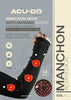

In France, work-related musculoskeletal disorders (WMSDs) are the leading cause of occupational illness. They mainly affect the arms, elbows, shoulders, and wrists, and affect screen-based workers, craftspeople, musicians, and athletes alike. The common denominator is repetitive movements, which subject the same tendons and muscle chains to continuous strain without adequate recovery. Here is how to identify the risk factors and take preventive action with ACU-DO self-massage.
Why do repetitive movements damage the arms?
A single movement is never problematic in itself. Repetition is what creates the danger. Every time you perform the same movement (typing on a keyboard, screwing, hitting a ball), the corresponding tendons and muscles undergo microtrauma. With sufficient recovery, the tissues regenerate and become stronger. Without recovery, microtrauma accumulates and the tendon fibers begin to deteriorate.
The 4 risk factors for arm-related work-related musculoskeletal disorders
-
Repetitive movements: continually strain the same muscle chains, creating imbalances and cumulative microtrauma (Large Intestine, Small Intestine, Triple Energizer, Heart Master meridians)
-
Prolonged static tension: holding the arm in a raised or extended position, very common in office work and manual trades (Triple Energizer meridian, point 5)
-
Poor posture: unsupported arm, raised shoulder, wrist in hyperflexion in front of a poorly positioned screen (Large Intestine meridian, points 4/11)
-
Insufficient recovery: working without adequate breaks prevents tendon fibers from regenerating between work sessions
Who is most at risk of arm-related work-related musculoskeletal disorders?
Remote workers and screen-based workers
The computer mouse is one of the main causes of work-related musculoskeletal disorders affecting the elbow and wrist. It keeps the right arm (or left arm for left-handed users) in a static position and the wrist in constant deviation. After 6 to 8 hours a day, 5 days a week, the tendons of the lateral epicondyle are consistently overloaded (Small Intestine meridian 8). This is the mechanism behind tennis elbow in remote workers, now one of the most common occupational conditions.
ACU-DO Right Arm Sleeve | Preventing tennis elbow for remote workers |
Tendonitis & arm pain – ACU-DO Shiatsu Massage – VSAH
Craftspeople and manual workers
Plumbers, electricians, carpenters, painters, and construction workers: their repetitive movements (tightening, screwing, hammering, sanding) place intense strain on the forearm extensors and shoulder muscles. The combination of exertion, uncomfortable positions, and a lack of breaks creates ideal conditions for tendinitis and epicondylitis.
Tendonitis & arm pain – ACU-DO Shiatsu Massage – VSAH
ACU-DO Right + Left Arm Sleeve Pack| Tendinitis & epicondylitis – VSAH
Musicians
Pianists, guitarists, violinists, percussionists: intensive musical practice combines an extremely high repetition of fine movements, static tension in postural muscles, and fixed arm positions for hours at a time. Musicians are among those most affected by musculoskeletal disorders, with prevalence rates of up to 75% among professionals.
ACU-DO Left Arm Sleeve | Tendonitis, tennis elbow & epicondylitis – VSAH
Racket and contact sports players
Tennis, badminton, squash, golf, fencing: every smash, every swing, each attack subjects the elbow tendons to sudden and repeated extension strain. Without an appropriate recovery protocol after training, the risk of tennis elbow is very high, even among amateurs.
Tendonitis & arm pain – ACU-DO Shiatsu Massage – VSAH
The role of ACU-DO self-massage in preventing musculoskeletal disorders
The ACU-DO Arm Sleeve continuously stimulates TCM points directly linked to the tendons and muscles of the forearm, elbow, and shoulder. This regular stimulation produces 3 preventive effects:
-
Maintaining tendon flexibility: stimulation of points on the Large Intestine meridian 10/11 helps preserve the elasticity of the forearm extensor tendons
-
Improved local circulation: points on the Triple Burner meridian 5/6 promote blood flow to the tendons and accelerate the elimination of exercise metabolites
-
Reduction of static tension: the continuous pressure of the beads reduces tonic tension in the wrist and elbow flexor and extensor muscles
ACU-DO prevention protocol according to your profile
Remote worker and screen-based worker
-
Morning (15/30 min): Right Arm Sleeve or/and Left before starting the workday or during the lunch break (15/30 min): Sleeves Arm, arm resting on a table, elbow at 90 degrees
-
Evening (30/60 min): Arm Sleeves Arm for recovery
-
If both arms are painful: use thes 2 Sleeves Arms at the same times
Craftsperson and manual worker
-
Before starting work (15/30 min): D+G Pack during the warm-up period
-
Lunch break (15/30 min): D+G Pack, arms at rest
-
Evening after the day (30/60 min): D+G Pack for active recovery
Musician
-
Before or during practice (15/30 min): Sleeve for the dominant arm or D+G Pack for pianists
-
After practice (30/60 min): D+G Pack for reearlySleeveearlycovery, arms by your sides
-
Rest days (30/60 min): Preventive tendon care
Racket sport player
-
Before training (15/30 min): Right Arm Sleeve + gentle stretching
-
After training (30/60 min): D+G Pack for recovery
-
The day after the match (30/60 min): D+G Pack to reduce tendon soreness
To learn more, discover our other blogs:
ACU-DO | Relieve your everyday aches and pains – Shiatsu Massage – VSAH
Back pain & sciatica – ACU-DO Shiatsu Massage – VSAH
Tendonitis & arm pain – ACU-DO Shiatsu Massage – VSAH
Swollen ankles & water retention – Shiatsu Massage – VSAH
DIY and crafts: relieving arm pain and tendinitis – VSAH
Construction and manual trades: relieving arm pain – VSAH
Listening to your body: identifying tension and preventing pain with ACU-DO – VSAH
Daily well-being: taking care of yourself - Shiatsu Self-Massage – VSAH
Preventing arm, ankle, and back pain - ACU-DO Shiatsu Self-Massage – VSAH
Martial arts-Combat sports: recovery and relaxation with ACU-DO – VSAH
Self-massage between sessions: prolonging the effects of physiotherapy treatments – VSAH
Water retention: how to naturally relieve swollen ankles and heavy legs – VSAH
FAQ - Frequently asked questions about preventing upper-limb MSDs with ACU-DO
Are work-related upper-limb MSDs caused by repetitive movements reversible?
In the early stage (tension, functional discomfort), MSDs are generally reversible with suitable rest, a change in posture, and regular self-massage. At the advanced (established tendinitis, early(epicondylitis), recovery takes longer and often requires medical follow-up. This is why early intervention is essential.
Can ACU-DO Shiatsu self-massage replace breaks at work?
No. Self-massage complements breaks; it does not replace them. Active breaks (standing up, moving your arms, rotating your wrists) remain essential for breaking static tension cycles. ACU-DO is most effective as a ritual before and after work, or during breaks—not as a replacement for the breaks themselves.
Which ACU-DO Right Arm Shiatsu sleeve should be chosen for a remote worker who uses a mouse on the right?
The ACU-DO Right Arm Sleeve is recommended for remote workers who use a mouse on the right. It specifically targets the TCM points of the Large Intestine 10, 11 and TTriple RExtensor 5 of the right arm, directly linked to the tendons used when operating the mouse. If you alternate between both hands or have pain on both sides, choose the D+G Pack.
After how many hours of repetitive work should the ACU-DO Shiatsu self-massage method be used preventively?
After 3 to 4 hours of repetitive work per day, one preventive ACU-DO session per day is appropriate. Beyond 6 hours, two sessions (morning and evening) are recommended. These thresholds are indicative: listen to your body—the first appearance of functional discomfort is the signal to begin prevention.
Can it be used the ACU-DO Shiatsu self-massage method during work?
Yes, theThe ACU-DO sleeve can be worn during light office activities (keyboard typing, meetings).
Continuous use is not recommended for more than 2 to 3 consecutive hours without a break. Alternating use with rest optimizes the effects.
The ACU-DO method is a complementary tool and should not replace medical advice in the event of a confirmed problem.
Keywords
Information
-
, even Author Article title
-
, even Author Article title